
Why a weekender should not be a single void
Open most weekenders and you find the same thing: one large cavity, a lining, perhaps a small pocket sewn in as an afterthought. You put six things in. To find one of them, you take out all six.
It is the part of a bag nobody photographs and everybody uses. The outside is what other people see. The inside is what you deal with, every morning, in a hotel room with the light still off.
We designed ours the other way round.
Why most bags are empty inside
There is a simple reason so many weekenders are a single space. An empty interior is cheaper to make, and it looks exactly the same in a product photo. Compartments add material, cutting and hours of stitching, and none of that shows from the outside.
The result is a bag that is beautifully finished on the surface and improvised within. You end up organising it yourself with pouches, wash bags and cable rolls, each one a small bag inside the bag.
A weekender should do that work on its own.
Four compartments, set into one wall
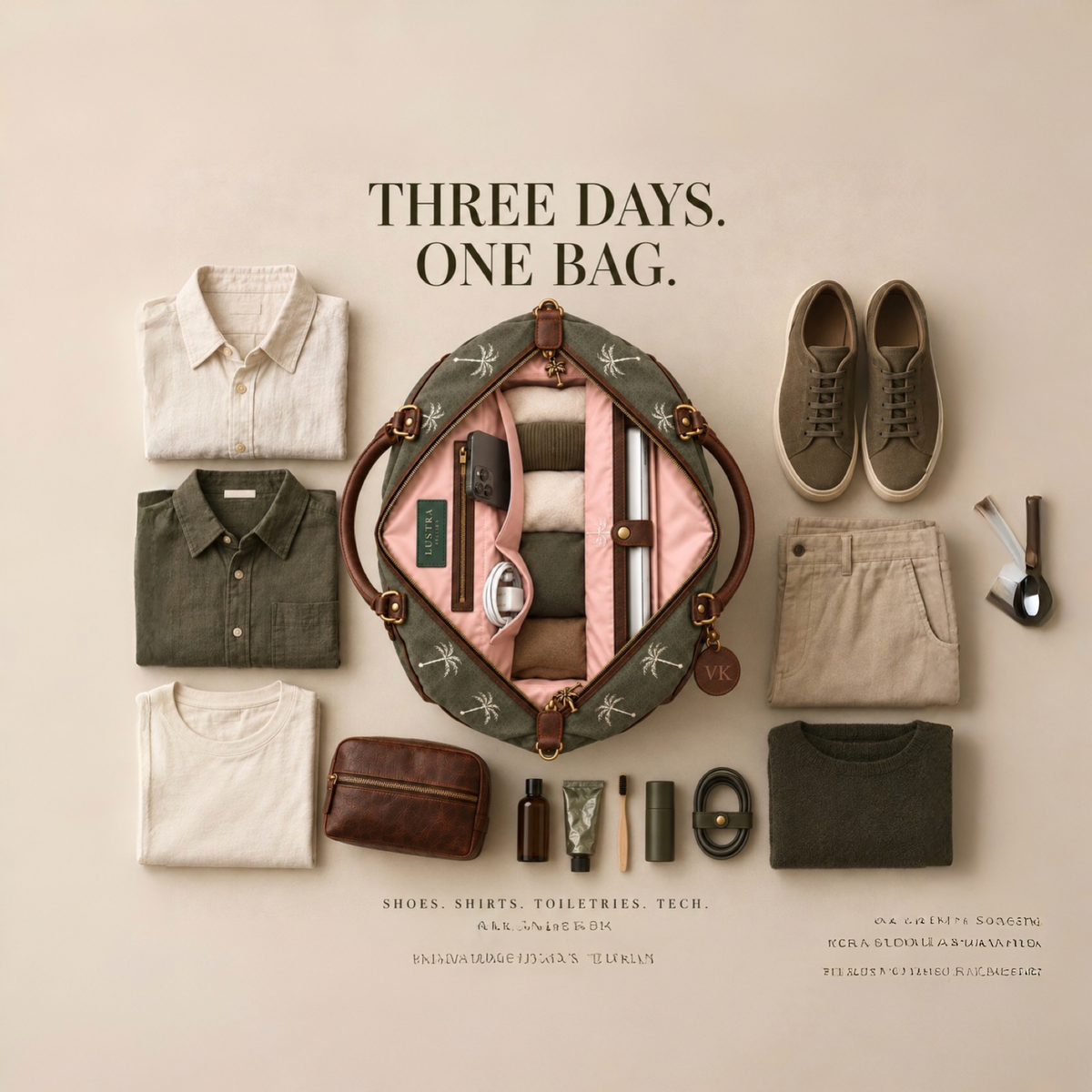
The interior of every LUSTRA is divided into four compartments, all set into a single wall. The rest of the bag stays open for clothes.
One zipped pocket. It runs vertically and closes fully. This is for the small things that must not go missing: passport, keys, the charging cable you always forget. They stay where they are, even when the bag is set down on its side.
Two open slips. For the things you reach for without looking: a phone, sunglasses, a charger, a boarding pass. Open, so a hand finds them in one movement.
One padded sleeve. Sized for a laptop, which stands upright and separate from everything else. A leather strap with a snap closes it, so the screen stays in place while the bag is carried, tilted or pushed into a luggage rack.
Placing all four on one wall is deliberate. Organisation should not cost you the main space. Shirts, a knit and a pair of shoes still go in flat and come out uncreased. The small things live along one side and never migrate into the middle.
A colour you can see into
The lining is Comporta Rose, the same in all three bags, named for the light on that stretch of Portuguese coast.
It is a considered choice, not a decorative one. Dark linings swallow things. A black key on black fabric in a dim room is a small daily frustration. A light, warm lining shows what is inside at a glance. You open the bag and you see.
It also changes how the bag feels when it opens. The outside is canvas or leather, reserved and practical. The inside is warm. That contrast is the part only the owner knows.
The marks, inside only
The brand name is not on the outside of the bag. It is on a single label, cream on Forest, 80 × 30 mm, set into the lining above the zipped pocket. Inside the bag you will also find the palm, embroidered into the lining, stitched and not printed.
Both are for the person who carries the bag, not for anyone watching them carry it. That is the point.
Why it matters more than it seems
A weekend is short. The time spent looking for things in a bag is small, a minute here, two minutes there. But it is also the texture of a trip: the passport at the gate, the charger at midnight, the key at the door after a long drive.
A considered interior removes those moments. What goes in comes out where you left it. It is not a feature you notice on the first day. It is the reason you still reach for the same bag years later.
Freedom, in practice, is mostly the absence of small frictions.
The Palm Trilogy — three weekenders with the same interior, the same construction and the same measure. See the bags or read how they are made.