
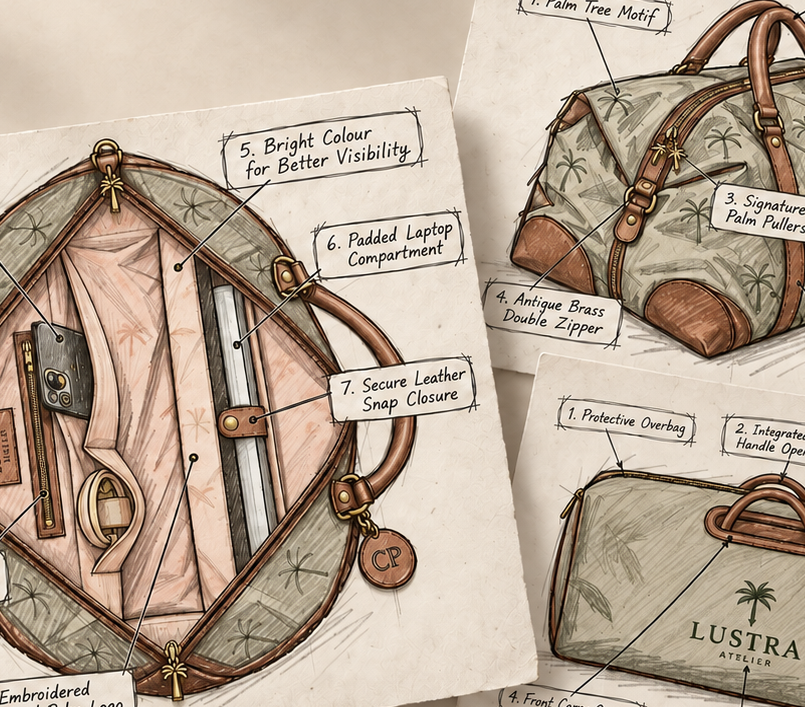
Materials, construction and marks, one by one
"Detail" is one of the most overused words in this industry. It usually means a contrast stitch, a logo plate or an extra zip, something to point at in a photograph.
We mean something else. A detail is a decision you only notice after years: whether a handle still holds, whether the canvas has softened or cracked, whether the brass has worn to something warmer or simply worn off. Most of those decisions are invisible on the first day. That is why they are worth writing down.
Materials that age, not ones that photograph
Every material in the Palm Trilogy was chosen for how it will look in ten years, not how it looks in a product shot. None of them is coated to stay new.
Waxed canvas, The Hedonist. A densely woven cotton, finished with wax so it sheds rain. It takes a crease and keeps it, and over time the surface develops a soft, uneven depth where hands and weather have been.
Heritage canvas, The Libertine. The same weight in a muted khaki. It is the lightest of the three bags, around 800 grams, and the most forgiving: a colour that works in every light and draws attention in none.
Full-grain leather, The Sovereign. Uncorrected, which means the surface has not been sanded or embossed to look uniform. The grain is the hide's own. It darkens and opens over years into a patina that no other bag will repeat exactly.
Antique brass, left alone
The hardware on all three bags is solid antique brass, unlacquered. Lacquer keeps brass bright for a while and then flakes, leaving something that looks neither new nor old. Unlacquered brass does what brass is supposed to do: it loses its shine and keeps its colour, warming slowly where it is touched.
The zip pull is cast as a palm. It is the one piece of the bag designed to be handled every time it opens.
One hide for the trim
Handles, base corners and closure straps are cut from the same leather on every bag. It sounds like a small thing. It means that all the leather on one bag ages together, at the same rate and in the same direction. Nothing looks newer than anything else after five years.
Where bags fail, built twice
A weekender almost never fails in the middle of a panel. It fails at the handle root, the point where the whole weight of a packed bag arrives at a single seam, again and again, every time it is lifted.
That is where ours are built twice. The handles are multi-layer leather, reinforced at the root and secured through the panel. The load-bearing seams are sewn by hand, doubled and locked at the stress points. The base is reinforced and set apart, so the bag stands on the floor rather than on its contents.
None of this is visible. It is the reason the bag will still be carried when the shine has long gone from the brass.
The palm, stitched
The palm runs across the body of every bag. On canvas it is cream; on leather it is a salmon-rosé. In every case it is embroidered, not printed.
The difference only becomes clear with time. A print sits on the surface and wears away with it. Embroidery is part of the fabric. It flattens slightly, softens, and ages with the canvas or leather around it, rather than peeling off it.
The marks, kept quiet
There is no name on the outside of a LUSTRA. The brand appears once, on a label inside: cream on Forest, 80 × 30 mm, set into the lining above the zipped pocket.
The only mark that faces outward is the monogram tag, cut from the same hide as the handles and embossed with the owner's initials. Or left blank, if you prefer.
A bag that announces its maker is working for the maker. We would rather it worked for you.
Inside
The interior deserves its own explanation, and it has one: four compartments set into a single wall, a padded sleeve for the laptop and a lining in Comporta Rose, light enough to see into. We wrote about why in The considered interior.
Caring for it, briefly
Materials like these ask very little, provided they are not over-treated.
- Store the bag dry and upright, never folded.
- Canvas: brush it out. Treat marks cold and locally.
- Leather: a colourless balm twice a year, applied thinly.
- Brass: leave it alone.
Every mark the bag collects becomes part of it. A bag that looks new after five years has not been used for five years.
Made slowly, on purpose
Every LUSTRA is designed in Berlin and crafted by hand in Pakistan, in small, controlled runs. Each specification is agreed piece by piece before the first cut, and each bag is made to order rather than taken from a shelf.
That takes longer. It is also the only way we know to make something worth keeping.
The Palm Trilogy — three expressions, one conviction. The same interior, the same construction, the same measure. See the bags or read The Details.